
How Advanced Technology Is Changing Injury Recovery
Modern day recovery is no longer guesswork, it’s guided by advanced technology that accurately tracks progress and maximizes injury recovery.
Recovery Is More Than Just Feeling Better
If you’ve ever been injured, you know how frustrating recovery can be. Maybe you’ve finished physical therapy, your pain has improved, but something still doesn’t feel quite right.
Your knee feels unstable when you go down stairs, or your shoulder just doesn’t have the same strength that it used to.
Or maybe you’re an athlete who wants to get back to your sport but you’re not sure if your body is truly ready.
The truth is that recovery isn’t just about waiting for time to pass or hoping that the pain goes away. It’s about restoring strength, movement, balance, and confidence.
At Pharaoh Health and Rehab, we believe that the best rehabilitation programs are built on objective data, not guesswork.
That’s why we incorporate advanced technology into our treatment plans to help monitor progress, identify weaknesses, and create personalized treatment programs that evolve with you every step of the way.
Why Traditional Rehabilitation Doesn’t Always Tell the Whole Story
One of the biggest challenges in injury recovery is that pain doesn’t always tell us the whole story.
A patient may report feeling significantly better after a surgery or an injury, but that doesn’t necessarily mean their body has fully recovered. Hidden strength deficits, movement pattern compensations, and balance impairments can remain long after symptoms improve.
These deficits may increase the risk of reinjury if they aren’t identified or addressed.
Many rehabilitation programs rely heavily on patient feedback and visual observation. While both are important, they don’t always provide measurable information about how the body is functioning.
That’s where advanced technology and objective data becomes invaluable.
Rather than us asking “Does it feel better?” we can also ask:
- Is your strength improving?
- Is your balance returning?
- Are both sides of your body working together the way they should?
Those answers help guide better treatment decisions throughout the rehabilitation process.
Our Approach: Using Technology to Guide Recovery
At Pharaoh Health and Rehab, advanced technology doesn’t replace our hands-on care or individualized chiropractic treatment; it enhances it.
Every patient heals differently, which means every rehab program should evolve based on measurable progress.
Instead of following the exact same exercises from start to finish, we continually assess how your body is responding to treatment and adjust your program accordingly. This allows us to reinforce areas that still need improvement while building on the progress you’ve already made.
Whether you’re recovering from surgery, dealing with a sports injury, or simply trying to move without pain again, objective testing helps us understand exactly where you are in your recovery, not just where we anticipate you to be.
We Measure Progress with Our or Advanced VALD Performance System
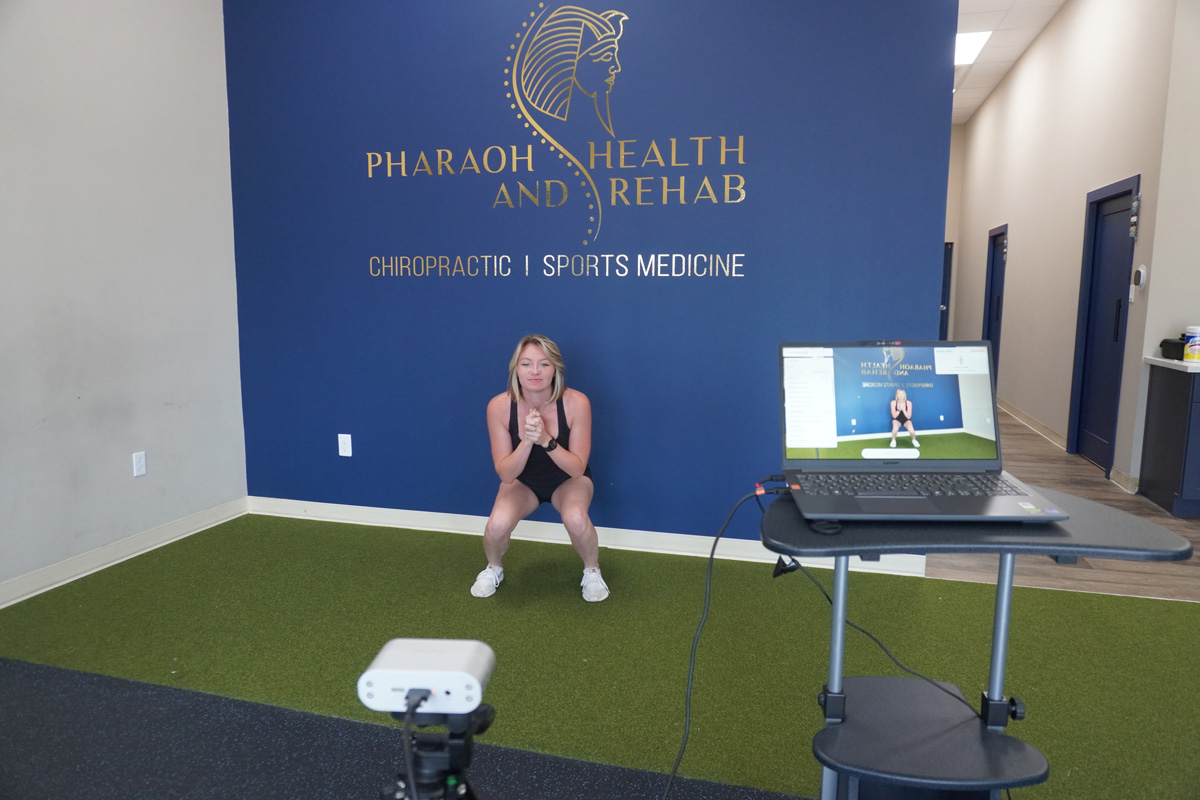
One of the advanced technologies we use here at Pharaoh Health and Rehab is the VALD Performance System.
This system allows us to objectively measure real-time data using strength, balance, power, movement quality, posture, and more throughout your rehabilitation. Instead of relying solely on observation, we can collect measurable data and compare it over time.
Imagine a patient recovering from an ACL reconstruction.
During their first visit with us, we perform baseline testing to evaluate how both legs are functioning. This gives us a clear picture of their current abilities and any significant deficits that may exist. Several weeks later, we repeat those same tests.
Maybe their quad strength has improved considerably, but their hamstring strength is still falling behind.
Perhaps their balance has normalized, but they continue to produce less force through the surgical leg during functional movements.
Without objective testing, these deficits can be difficult to recognize. Using the real-time data from the performance system, we can modify the treatment based on the patient’s actual performance.
For our athletic population, this information is especially valuable. Returning to sport too early or without adequate strength and conditioning can increase the risk of reinjury.
Objective performance testing provides us with that valuable information that can help us determine whether an athlete is progressing towards a safe return to their sport, while also identifying areas that still require attention.
Ultimately, recovery isn’t measured by how much time has passed, it’s measured by how well your body is functioning.
Technology Helps Us Personalize Every Recovery
No two injuries are alike.
Even two patients with the same diagnosis may recover at completely different rates. Age, activity level, surgical technique, previous injuries, overall health, and daily demands all influence the rehabilitation process.
That’s why we don’t believe in cookie-cutter treatment plans.
Objective testing allows us to personalize care based on what your body needs today.
As your recovery progresses, your treatment adapts and progresses with you.
Maybe today’s priority is restoring range of motion. A few weeks later it becomes rebuilding strength. Later still, it shifts towards improving power, balance, and confidence with higher level movements.
Using advanced technology allows us to make those decisions using measurable information instead of assumptions.
A Smarter Way to Recover
Whether you’re a competitive athlete preparing to return to your sport, a weekend warrior hoping to stay active, or someone simply trying to get back to their everyday life without pain, objective testing can make a meaningful difference in your recovery.
Advanced technology isn’t what heals the injuries, your body does that for you.
What advanced technology does is give us better information. It helps us identify strengths, uncover hidden deficits, monitor progress over time, and make informed decisions throughout your rehabilitation.
At Pharaoh Health and Rehab, we combine evidence-based technology with individualized treatment, hands-on care, and clinical experience to help you recover with confidence.
Give us a call to book your Performance Analysis today!
Answering Your Most Frequently Asked Questions (FAQs) About Using Our Advanced Technology Solutions for Injury Recovery
Do I have to be an athlete to benefit from this technology?
Not at all. Whether you’re recovering from surgery, managing chronic pain, or working to improve your movement and function, performance testing is beneficial to all.
How often will I be tested?
Testing frequency depends on your injury, diagnosis, and personalized treatment plan. We establish a baseline early in rehabilitation and repeat testing periodically to monitor progress and adjust treatment as needed.
Does technology replace hands-on treatment?
No. Technology is simply another tool that helps us collect objective information.
Can advanced technology help prevent future injuries?
Objective testing can identify movement asymmetries, strength deficits, and other areas that may increase injury risk. While our data can’t predict a future injury, it can help prevent injury by showing us which area(s) we need to address and improve to reduce the likelihood of future injuries.
References
- Bizzini, M., & Impellizzeri, F. M. (2020). Return to sport after anterior cruciate ligament reconstruction: How current evidence should guide clinical practice. Sports Medicine, 50(9), 1527-1539.
- Buckthorpe, M., & Della Villa, F. (2020). Optimising the late-stage rehabilitation and return-to-sport training following ACL reconstruction. Sports Medicine, 50(4), 657-678.
- Dai, B., Mao, D., Garrett, W. E., & Yu, B. (2024). Validity and reliability of portable force plates for assessing countermovement jump performance. Physical Therapy in Sport, 68, 71-79.
- Hickey, J. T., et al. (2024). Wearable technology for physical activity and rehabilitation after orthopaedic surgery: A systematic review. BMJ Open, 14, e082287.
- VALD. (2024). Managing return to sport following semimembranosus reconstruction. https://valdperformance.com/en/news/research-summary-managing-rts-of-elite-footballers-following-semimembranosus-reconstruction